
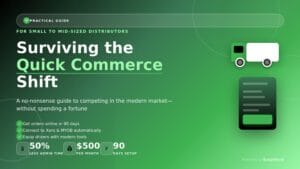
If you’re running a small or mid-sized food and beverage distribution business in Australia or New Zealand, you’ve probably noticed things are changing fast. Your customers are asking for more frequent deliveries. New competitors are popping up. And you’re hearing about “dark stores” and “micro-fulfilment centres” and wondering what it all means for your business.
Here’s the truth: The big players like Woolworths and Coles are investing millions in new technology and fulfilment centres. But that doesn’t mean smaller distributors are doomed. In fact, there’s massive opportunity for nimble, well-run distribution businesses who adapt smartly without breaking the bank.
This article is written for distributors who:
- Currently use Xero or MYOB for accounting (not massive ERP systems)
- Have between 20-200 customers
- Employ 1-20 staff
- Still take orders by phone, email, and text
- Run 1-10 delivery vehicles
- Want to grow but don’t have millions to invest in technology
Let’s talk about what’s really happening, what you actually need to do about it, and how you can compete without spending a fortune.
What’s Actually Changing (In Plain English)
1. Your Customers Want Faster, More Frequent Deliveries
Five years ago, most of your customers were happy with weekly deliveries. Today, cafes, restaurants, and even small retailers want deliveries 2-3 times per week or even daily. Why? Because they’re trying to reduce their own storage costs and keep products fresher.
This trend accelerated during COVID and it’s not going back. The challenge for you: more frequent deliveries mean higher fuel costs, more driver time, and smaller order sizes on each run.
2. Online Ordering Isn’t Optional Anymore
Your customers are busy. They don’t want to call you, wait on hold, and read out their order over the phone. They want to place orders online at 11pm when they’re doing their weekly planning. If you don’t offer online ordering, they’ll switch to a competitor who does.
The good news: Setting up online ordering isn’t as expensive or complicated as it used to be.
3. Dark Stores Are Creating New Customers (And New Demands)
“Dark stores” are basically small warehouses in suburban areas that fulfil online grocery orders in under an hour. Woolworths has opened one in Mascot, Sydney. Coles is rolling them out. These facilities need suppliers who can deliver multiple times per day with accurate inventory tracking.
For smaller distributors, dark stores can be great customers—they order frequently and pay quickly. But they also have higher standards for reliability and technology integration than traditional retail stores.
4. Your Margins Are Getting Squeezed
Everyone in the supply chain is facing pressure. Your suppliers are increasing prices. Your customers are demanding better pricing. Fuel costs keep rising. Labour is expensive. The only way to maintain profitability is to operate more efficiently—doing more with less.
The Three Things Small Distributors Must Do (Not Ten, Just Three)
Forget the fancy strategies and complicated transformations. If you’re a smaller distributor, there are really only three critical things you need to do:
1. Get Your Orders Online
Why it matters: Taking orders by phone, email, and text is killing your efficiency. Your staff spend hours each day entering orders, calling customers back to clarify, and fixing mistakes. Every minute spent on order entry is a minute not spent on growing the business.
What it looks like: Customers log into your website (or a simple app), see your products with live pricing, place their order, and it automatically goes into your system. No phone calls needed.
The mistake to avoid: Building a complicated custom website. You don’t need to spend $50,000 on custom development. Modern ordering systems designed for food distributors start around $300-500 per month and include everything you need.
How EasyVend helps: EasyVend’s online ordering portal lets customers place orders 24/7, with orders automatically flowing into your system without manual data entry. Your customers see accurate pricing, current stock levels, and their order history. No more phone tag.
2. Connect Your Systems (Especially Your Accounting)
Why it matters: If you’re using Xero or MYOB for accounting, but orders are tracked in spreadsheets or a separate system, someone has to manually enter data twice. That’s slow, expensive, and creates errors. When you’ve got 50 orders per day, manually entering invoices into Xero takes hours.
What it looks like: When a customer places an order in your ordering system, it automatically creates an invoice in Xero or MYOB. When they pay, the payment automatically reconciles. Your bookkeeper sees everything in real-time without entering anything manually.
The mistake to avoid: Thinking integration is too technical or expensive. Modern systems are built to connect to Xero and MYOB with just a few clicks—no IT expertise required.
How EasyVend helps: EasyVend integrates directly with both Xero and MYOB, automatically syncing customer orders, invoices, and payment receipts to avoid costly mistakes and double handling of data. It auto-syncs invoices and payments between EasyVend and your accounting tools, eliminating duplicate entries with two-way integration.
3. Give Your Drivers Proper Tools
Why it matters: Your drivers are your frontline. If they’re working off printed lists, making notes on paper, and bringing paperwork back to the office for someone else to enter into the computer, you’re wasting massive amounts of time and creating opportunities for errors.
What it looks like: Your driver starts the day with their route on their phone or tablet. They see what to deliver to each customer. When they arrive, they can quickly record what was delivered, get a digital signature, and take a photo of the delivery. All this information immediately syncs back to your office system.
The mistake to avoid: Expensive, complicated systems that require special hardware. Your drivers should be able to use their own phones or basic tablets.
How EasyVend helps: EasyVend’s MiniVend tool gives drivers a fast, flexible, real-time delivery system that runs in any web browser—no app to install. It syncs with EasyVend in real time, captures proof of delivery with signatures and photos, and tracks products and containers delivered.
“But I Can’t Afford Expensive Software!”
This is the most common objection we hear from smaller distributors. You see big companies spending hundreds of thousands on ERP systems and assume any proper technology is out of reach.
Here’s the reality: Modern cloud-based software designed specifically for food distributors costs a fraction of traditional ERP systems. We’re talking $300-500 per month, not $100,000 upfront plus $20,000 per year in maintenance.
Let’s do the maths on what inefficient processes are actually costing you:
Manual order entry: If someone spends 3 hours per day taking and entering phone orders at $30/hour, that’s $90 per day or $23,400 per year in labour just for order entry.
Invoice processing: If creating and sending invoices manually takes 2 hours per day at $30/hour, that’s $60 per day or $15,600 per year.
Driver administration: If processing driver paperwork and entering delivery data takes 2 hours per day at $30/hour, that’s $60 per day or $15,600 per year.
Total cost of manual processes: $54,600 per year.
Now compare that to software that costs $50 per month ($600 per year) and eliminates most of this manual work. You’re saving $54,000 per year. The software pays for itself in the first month.
And that’s before considering the additional revenue you’ll generate from:
- Customers ordering online outside business hours
- Faster order processing meaning you can handle more customers
- Fewer errors reducing waste and customer complaints
- Better data helping you optimise routes and inventory
What You DON’T Need (Save Your Money)
Here’s what smaller distributors often waste money on:
❌ A custom-built website: Off-the-shelf systems designed for food distribution work better and cost 10% of custom development.
❌ Complex ERP systems: SAP, Oracle, and similar enterprise systems are designed for companies with 500+ employees. They’re overkill for most small-to-mid distributors and will cost you hundreds of thousands.
❌ Expensive custom integration: Modern systems have built-in connections to Xero, MYOB, and payment processors. You shouldn’t be paying developers to build custom integrations.
❌ Special hardware: You don’t need expensive handheld devices or specialised tablets. Software that runs in web browsers works on phones and tablets your staff already own.
❌ Big consulting firms: Large consultancies will charge you $50,000 to tell you what to do. Software companies that specialise in food distribution understand your business and can get you set up for a fraction of the cost.
The 90-Day Implementation Plan
You don’t need a two-year digital transformation. Here’s a realistic 90-day plan to get the core systems working:
Month 1: Get Set Up
- Week 1-2: Choose your system (we recommend looking at EasyVend, but do your research)
- Week 2-3: Import your customer list and product catalogue
- Week 3-4: Connect to your accounting software (Xero or MYOB)
- Week 4: Train your office staff
Month 2: Roll Out to Customers
- Week 5: Select 5-10 friendly customers to pilot online ordering
- Week 6-7: Get feedback and fix any issues
- Week 8: Invite all customers to start ordering online
Month 3: Add Driver Tools
- Week 9-10: Train drivers on the delivery app
- Week 11: Run parallel (paper and digital) to ensure comfort
- Week 12: Switch fully to digital delivery recording
By day 90, you should have:
- Customers placing 50%+ of orders online
- Invoices automatically syncing to your accounting software
- Drivers using digital tools for delivery management
- Saved at least 10+ hours per week in manual admin work
Real Benefits You’ll See Immediately
Time Savings
According to EasyVend customers, admin time has been cut in half, and they’ve stopped losing orders. That’s a realistic expectation. You’ll spend less time on data entry and more time on activities that grow revenue.
Fewer Errors
When customers enter their own orders online, they own the accuracy. When data flows automatically from ordering to invoicing to accounting, there’s no opportunity for transcription errors. Fewer errors mean fewer disputes, credits, and customer complaints.
Better Cash Flow
Automated invoicing means customers get invoiced immediately after delivery. Built-in payment processing means customers can pay by credit card instantly. Integrated accounting means you can see exactly who owes what in real-time. All of this accelerates payment and improves cash flow.
Ability to Scale
The difference between handling 50 orders per day and 100 orders per day isn’t twice as much work—not if you’ve got systems. With efficient processes, you can grow revenue without proportionally growing headcount.
Happier Customers
Customers prefer ordering online at their convenience over calling during business hours. They like being able to see their order history and track deliveries. Better service leads to better retention and more referrals.
Quick Commerce Opportunities for Smaller Distributors
While the big retailers are building their own dark stores, there are several opportunities for smaller distributors:
1. Service the Retailers Too Small for Woolworths’ Attention
Independent retailers, specialty stores, and convenience shops still need suppliers. Many of them are also trying to offer quick delivery to their customers. Be the reliable partner who can deliver multiple times per week.
2. Specialise in Categories the Big Players Don’t Handle Well
The big distributors focus on high-volume commodity products. If you specialise in organic, ethnic foods, specialty ingredients, or artisan products, you can own niches they ignore.
3. Offer Superior Service in Regional Areas
The major retailers are building dark stores in Sydney, Melbourne, and Brisbane. But regional areas still need reliable distribution. Being the responsive, reliable distributor in Wollongong, Newcastle, Geelong, or Townsville is a defensible position.
4. Partner with Emerging Quick Commerce Platforms
New platforms are launching that need reliable distributors who can fulfil orders quickly. These platforms often prefer working with smaller, responsive distributors over large, bureaucratic ones.
How to Evaluate if a System Is Right for Your Business
When you’re looking at distribution software (like EasyVend or alternatives), here are the key questions to ask:
Does it handle your specific products?
Food distribution has unique requirements (temperature tracking, batch numbers, use-by dates). Make sure the system is designed for food, not generic wholesale distribution.
Does it integrate with your accounting software?
If you use Xero or MYOB, integration should be built-in and easy, not a custom project.
Can customers order online easily?
Test the customer ordering experience yourself. Is it intuitive? Can customers see stock availability and pricing? Can they access their order history?
Does it work for your drivers?
Will your drivers actually use it? Does it work on their phones? Is it fast enough that it doesn’t slow them down?
Is support provided in Australia/New Zealand time zones?
When something goes wrong at 5am before your morning deliveries, can you call someone who understands Australian food distribution and will answer?
Is pricing transparent and predictable?
Avoid systems with complicated per-transaction fees or hidden costs. You want a simple monthly price that’s easy to budget.
How long does implementation take?
You’re running a business—you can’t spend six months implementing software. Look for systems that can be live in 4-8 weeks.
Why EasyVend Makes Sense for Smaller Distributors
We’ve mentioned EasyVend several times in this article. Here’s why it’s worth considering:
EasyVend is developed by Jeal Tech, an Australian family-owned company trading since 1983 with over 1,200 satisfied clients in the Food and Beverage industry. They understand Australian distribution businesses because they’ve been serving them for 40 years.
Key advantages for smaller distributors:
Built for food distribution, not adapted from something else. Unlike other ERP systems designed for wholesale suppliers, EasyVend supports and automates every part of food distribution businesses specifically, freeing you up to grow sales.
Works with your existing accounting. Seamless integration with both Xero and MYOB means you don’t have to change your accounting system.
No complex IT needed. EasyVend is a web-based solution that’s completely accessible on any device, replacing heavy and extensive IT structures.
Modular and customisable. EasyVend is modular and can be tailored to match your exact processes, from product pricing rules to delivery scheduling—you only use the features you need.
Local support. EasyVend customers report calling for help at very late hours and weekends, with response always being “how can I help you”—support that’s invaluable when you’re running deliveries.
Covers the full process. From customer ordering to delivery to invoicing to payment to accounting integration, everything’s connected. You’re not juggling five different systems.
Common Concerns (And Honest Answers)
“My customers are old-school. They won’t order online.”
We hear this constantly. Here’s what happens: You launch online ordering and invite customers to try it. The first week, maybe 10% order online. A month later, it’s 30%. Three months later, it’s 60%+. Why? Because ordering online at 11pm while planning next week is easier than calling during business hours. Once customers try it, they prefer it.
And for customers who truly won’t order online? They can still call. But now your staff aren’t overwhelmed with phone orders and can provide better service to those customers who need the personal touch.
“What if the system breaks and we can’t take orders?”
Modern cloud-based systems are incredibly reliable—far more reliable than your computer systems in your office. But if there is an issue, you can always fall back to phone orders temporarily. The system will work 99.9% of the time.
“My staff will resist changing how we do things.”
Change is always hard. But consider how your staff actually feel about the current process. Do they enjoy spending three hours a day entering phone orders? Do they like manually typing invoices into Xero? Usually, staff resistance evaporates when they realise the new system makes their lives easier, not harder.
The key is involving staff early, training them properly, and listening to their feedback during implementation.
“We’re too busy to implement new systems.”
This is the classic catch-22. You’re too busy with manual processes to implement systems that would make you less busy. But consider: if you save 10 hours per week after implementation, you’ll have recovered the implementation time within a few months. And every week thereafter, you’re ahead.
The businesses that say “we’re too busy” are usually the ones who need better systems most urgently.
Action Steps: What to Do This Week
If you’re convinced that modernising your distribution business makes sense, here’s what to do in the next seven days:
Day 1-2: Calculate your cost of manual processes
Use the framework we provided earlier. How many hours per week does your team spend on order entry, invoice processing, and driver administration? What’s that costing you annually?
Day 3: Research solutions
Look at EasyVend and any competitors. Read reviews. Watch demo videos.
Day 4-5: Book demonstrations
Get demonstrations from 2-3 providers. Ask them the evaluation questions we listed earlier. See the software working with real data.
Day 6: Talk to current customers of the software
Ask the vendor for references—actual distributors using their system. Call them and ask honest questions about what works and what doesn’t.
Day 7: Make a decision
Choose a system and commit to moving forward. Don’t get stuck in analysis paralysis. You can always refine and optimise later—the cost of delay is too high.
The Bottom Line
The food distribution industry in Australia and New Zealand is changing fast. Quick commerce, online ordering, and higher customer expectations aren’t going away. The big players are investing millions in technology and infrastructure.
But smaller distributors have advantages too: You’re more nimble. You can make decisions quickly. You can offer personalised service. And you can implement technology that gives you 80% of the benefit at 10% of the cost.
The distributors who will thrive in the next five years are those who:
- Stop taking orders by phone and get customers ordering online
- Connect their systems so data flows automatically
- Equip their drivers with proper digital tools
- Focus on efficiency so they can grow without proportionally increasing costs
You don’t need millions of dollars or a two-year transformation project. You need practical, affordable systems designed for businesses like yours. Solutions like EasyVend exist specifically to help small and mid-sized food distributors compete in the modern market without breaking the bank.
The question isn’t whether to modernise—it’s whether you’ll do it proactively now, or reactively later after losing customers to more efficient competitors.
What will you choose?
Ready to see how EasyVend can transform your distribution business?
Book a free demonstration to see the software in action with real food distribution scenarios. No sales pressure—just a practical look at whether it’s right for your business.